
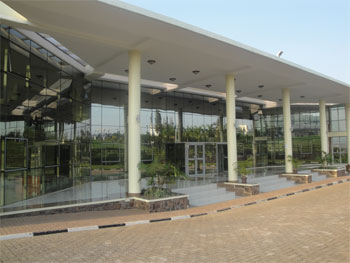
Kigali Public Library
In 1994, Rwanda experienced a genocide in which approximately one million Rwandans were killed. Through the establishment of the Kigali Public Library, Rwanda’s first-ever public library, it is our hope that the tools used for destruction will be replaced with tools of knowledge. Successful completion of this monumental effort marks a watershed in Rwanda’s history, finally providing unfettered access to a treasure trove of knowledge that has so far been unavailable to a population of over eleven million people. The library—a sanctuary for knowledge and a forum for the free exchange of ideas—is also a monument to serve as a permanent reminder to all Rwandans and the rest of the world that the atrocities committed in 1994 will never be forgotten.
The Kigali Public Library was initiated in 2000 by the Rotary Club of Kigali-Virunga, Rwanda (RCKV). Soon thereafter, it gained the ardent support of the American Friends of the Kigali Public Library (AFKPL), which was established in Washington, DC, in 2001. In April 2012, the RCKV and the AFKPL completed a multi-million dollar fundraising campaign to build, equip, and staff the Kigali Public Library. On Friday, October 5, 2012, the KPL was officially inaugurated.